

KeychainX Study Finds $2.7B in Presale ETH Never Moved
The Ethereum presale opened twelve years ago, on July 22, 2014. Today, 621 of its original genesis wallets — holding 1,421,008 ETH, about $2.7 billion — have still never moved
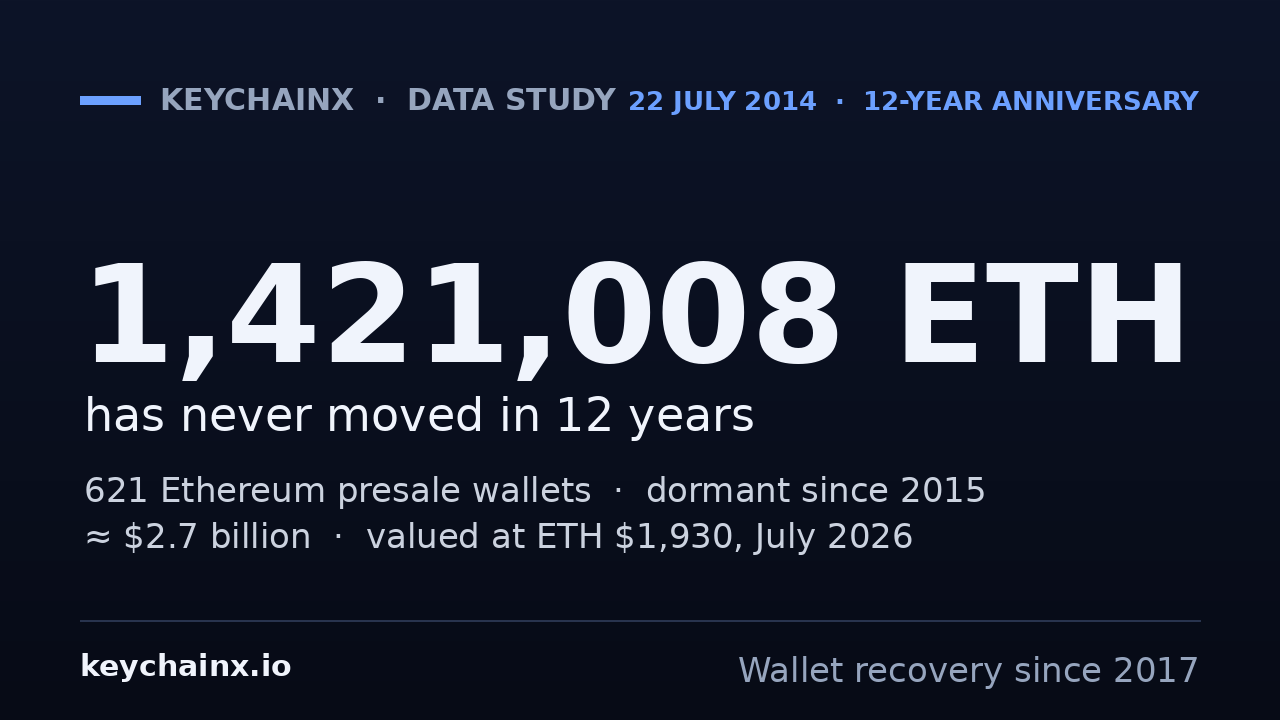
ZUG, Switzerland, July 21, 2026 (GLOBE NEWSWIRE) -- Twelve years ago, on July 22, 2014, the Ethereum presale opened. KeychainX, a Swiss cryptocurrency wallet-recovery firm, has released an on-chain study of the sale. It found that 621 of the original genesis wallets have never sent a single transaction in the twelve years since, holding 1,421,008 ETH — about $2.7 billion at current prices. The study also identified 30 presale wallets that moved for the first time in 2025 and 2026 after roughly a decade of dormancy.
On-chain data was captured on July 19, 2026, and valued at an ETH price of about $1,930 on July 21, 2026; dollar figures change as the ETH price and the underlying wallets move.
Key Findings
- 8,893 Ethereum presale genesis addresses were scanned.
- 621 of them (7.0%) have never sent a transaction — a nonce of zero.
- 1,421,008 ETH remains dormant in those wallets, about $2.7 billion at an ETH price of $1,930.
- That is roughly 2.4% of the approximately 60 million ETH sold in the presale.
- 30 wallets moved for the first time in 2025 and 2026, sending about 67,900 ETH (about $131 million).
A 12-Year-Old Crowdsale, Measured On-Chain
The Ethereum presale ran for 42 days, from July 22 to September 2, 2014, selling roughly 60 million ETH at about $0.31 each and raising around 31,500 BTC. Buyers received their allocations in the network's 2015 genesis block. A significant share of those wallets have not moved since.
KeychainX scanned every presale genesis address to measure how many wallets, and how much ETH, remain with no outgoing transaction. Balances and transaction counts are public values that can be reproduced on any Ethereum node or block explorer.
How the Study Was Measured
The method reads two public values for each of the 8,893 presale genesis addresses: the account's transaction nonce and its ETH balance. A nonce of zero indicates the address has never broadcast an outgoing transaction, meaning the original allocation has never been spent or moved. For any wallet that had moved, the study also recorded the date and size of its first outflow. All values were read on July 19, 2026.
Some earlier counts cite roughly 521,000 ETH across about 620 wallets. That figure counts only addresses whose sole transaction is the incoming genesis allocation, which excludes any wallet that later received an airdrop, transfer, or spam token — even if the owner never sent anything out. The KeychainX study counts wallets with a nonce of zero, which captures every address whose owner has never moved funds. The largest example is a 250,000-ETH wallet that has collected airdropped tokens for years but has never broadcast an outgoing transaction.
Where the Dormant ETH Sits
The dormancy is concentrated. The 29 wallets holding 10,000 ETH or more account for 825,321 ETH, about 58% of the dormant total, and the ten largest alone hold 523,322 ETH. At the other end, 186 wallets under 100 ETH hold about half a percent between them.
| ETH balance band | Dormant wallets | ETH held | Share of dormant ETH |
| 10,000+ ETH | 29 | 825,321 | 58.0% |
| 1,000–10,000 ETH | 202 | 525,698 | 37.0% |
| 100–1,000 ETH | 200 | 63,256 | 4.5% |
| 10–100 ETH | 186 | 6,733 | 0.5% |
| Under 10 ETH | 4 | ~0 | 0.0% |
| Total | 621 | 1,421,008 | 100% |
Wallets Waking Up in 2025 and 2026
The dormant pool is not static. The study verified each wallet's first-ever outflow date to distinguish genuine awakenings — wallets untouched for roughly a decade that then moved — from addresses that had been active all along.
In 2025, 20 presale wallets moved for the first time, sending about 52,755 ETH, led by a single wallet that moved 40,000 ETH. In 2026 to date, another 10 have moved, sending about 15,164 ETH, including one wallet of 10,000 ETH. Together that is 30 wallets and roughly 67,900 ETH, about $131 million at current prices.
Of the 30 wallets, 22 were emptied almost completely rather than partially moved; eight moved part of their balance and still hold ETH. KeychainX reports that it has recovered access to several 2014 presale wallets for their owners during this 2025–2026 period, in cases where the wallet file survived but the stored password no longer decrypted it.
“Every time one of these wallets moves, it is a reminder that a large share of this ETH is not gone — it is stuck,” said Peter M., Chief Financial Officer of KeychainX. “In most of the cases we see, the owner is convinced the password is correct and cannot understand why it fails. It usually comes down to how a 2014 browser encoded a single non-standard character. When we reproduce that, the wallet opens.”
Dormant Does Not Mean Lost
A nonce of zero shows that a wallet has never moved; it does not show that a wallet is lost. The dormant set is mixed. Some holdings are deliberate long-term positions, and some addresses may belong to early contributors or foundations. A portion are likely lost or forgotten — misplaced wallet files, forgotten passwords, or abandoned presale files. The study measures the size of the pool rather than labeling each address.
Independent researchers have reached similar orders of magnitude. Coinbase executive Conor Grogan has estimated that more than 900,000 ETH is likely lost permanently.
Documented Cases
The public record includes several presale participants who lost or cannot reach their ETH. The best-known is a 250,000-ETH wallet attributed to Rain Lõhmus, a founder of Estonia's LHV Bank, who bought the stake for about $75,000 in 2014 and has said he lost access; the wallet has never moved and is worth about $483 million at an ETH price of $1,930. Other reported cases include a family unable to access roughly $6 million in presale ETH, and a buyer of about 1,970 presale ETH who lost the wallet file after storing it in a deleted email.
Why Some 2014 Passwords Fail
Ethereum's presale wallets were encrypted by 2014-era browser JavaScript and are decrypted today by modern software. As a result, a single non-ASCII character can be represented as different bytes than were originally stored, so a password the owner remembers correctly can still fail to decrypt. Documented causes include Unicode normalization differences (NFC versus NFD), macOS smart quotes and accented characters, and keyboard-layout remaps. Where the presale wallet file still exists, these encoding mismatches can often be reproduced and the wallet opened; where the file itself is gone, recovery is not possible.
About KeychainX
KeychainX AG is a cryptocurrency wallet-recovery company based in Baar, Zug, Switzerland, founded in 2017. It helps individuals and organizations regain access to lost or locked crypto wallets, including 2014 Ethereum presale wallets, keystore files, and hardware and software wallets. The company has assisted more than 1,000 clients. More information is available at KeychainX.

Media Contact

Peter M.
Chief Financial Officer, KeychainX
mail@keychainx.io

KeychainX Study Finds $2.7B in Presale ETH Never Moved
KeychainX Study Finds $2.7B in Presale ETH Never Moved
Legal Disclaimer:
EIN Presswire provides this news content "as is" without warranty of any kind. We do not accept any responsibility or liability for the accuracy, content, images, videos, licenses, completeness, legality, or reliability of the information contained in this article. If you have any complaints or copyright issues related to this article, kindly contact the author above.
