

Alternative Credentials Market to Reach US$ 57.5 Billion by 2033, Growing at 17.5% CAGR from 2026–2033
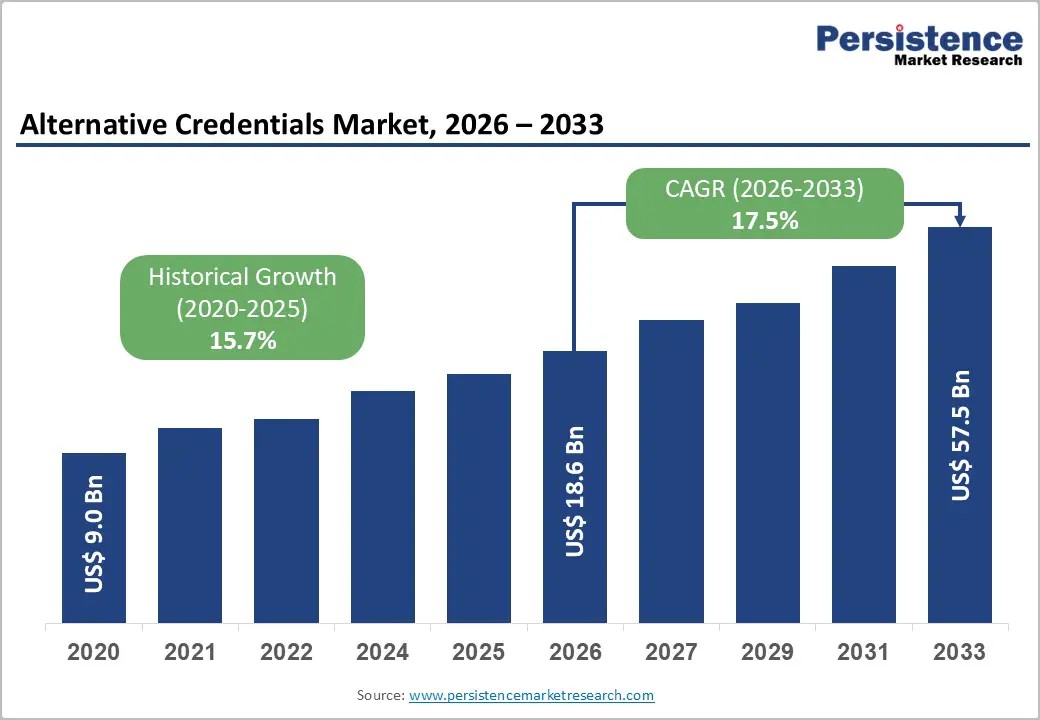
The global alternative credentials market size is valued at US$ 18.6 Bn in 2026 and is expected to reach US$ 57.5 Bn by 2033, growing at a CAGR of 17.5%
BRENTFORD, ENGLAND, UNITED KINGDOM, June 29, 2026 /EINPresswire.com/ -- The global Alternative Credentials Market is experiencing rapid transformation as education systems and labor markets shift toward skills-based hiring and lifelong learning models. The market is valued at US$ 18.6 billion in 2026 and is projected to reach US$ 57.5 billion by 2033, growing at a robust CAGR of 17.5% during the forecast period. This strong expansion reflects the growing acceptance of non-degree qualifications such as micro-credentials, professional certificates, and digital badges as credible indicators of job readiness across industries.
A major factor driving this growth is the increasing demand from employers for verifiable, job-ready skills rather than traditional academic qualifications. Organizations across technology, finance, healthcare, and manufacturing are adopting skills-first hiring models to address talent shortages and improve workforce agility. Additionally, the rise of digital learning platforms, AI-driven education systems, and blockchain-based credential verification is making alternative credentials more accessible, affordable, and trustworthy. North America leads the market with approximately 39.8% share, supported by strong enterprise adoption and mature digital infrastructure, while Asia Pacific is emerging as the fastest-growing region, driven by large-scale government skilling initiatives and rapid digital transformation.
𝐆𝐞𝐭 𝐚 𝐒𝐚𝐦𝐩𝐥𝐞 𝐏𝐃𝐅 𝐁𝐫𝐨𝐜𝐡𝐮𝐫𝐞 𝐨𝐟 𝐭𝐡𝐞 𝐑𝐞𝐩𝐨𝐫𝐭: https://www.persistencemarketresearch.com/samples/36716
Market Segmentation
The Alternative Credentials Market is segmented by credential type, delivery mode, and end-user. By credential type, it includes professional certificates, micro-credentials, digital badges, bootcamps, and nano-degrees. Professional certificates lead the market due to strong employer recognition and alignment with job roles, while digital badges are the fastest growing because they offer flexible, verifiable skill validation.
By delivery mode, the market is divided into online/hybrid and fully online learning. Online/hybrid formats dominate as they combine flexibility with structured learning, while fully online learning is expanding rapidly due to scalability, lower cost, and global accessibility through platforms like Coursera, edX, and Udemy.
By end-user, the market serves enterprises, higher education institutions, governments, and individual learners. Enterprises are the largest segment, driven by rising investment in reskilling and upskilling programs, while governments increasingly integrate micro-credentials into national workforce development frameworks.
Regional Insights
North America leads the market with 39.8% share, supported by strong adoption of skills-based hiring and advanced digital learning platforms like Coursera and LinkedIn Learning.
Europe follows with a structured, policy-driven approach focused on standardized micro-credentials and lifelong learning initiatives that improve cross-border recognition.
Asia Pacific is the fastest-growing region, driven by large-scale government skilling programs, rapid digital adoption, and expanding access to affordable online education in countries such as India, China, and Japan.
𝐃𝐨 𝐘𝐨𝐮 𝐇𝐚𝐯𝐞 𝐀𝐧𝐲 𝐐𝐮𝐞𝐫𝐲 𝐎𝐫 𝐒𝐩𝐞𝐜𝐢𝐟𝐢𝐜 𝐑𝐞𝐪𝐮𝐢𝐫𝐞𝐦𝐞𝐧𝐭? 𝐑𝐞𝐪𝐮𝐞𝐬𝐭 𝐂𝐮𝐬𝐭𝐨𝐦𝐢𝐳𝐚𝐭𝐢𝐨𝐧 𝐨𝐟 𝐑𝐞𝐩𝐨𝐫𝐭: https://www.persistencemarketresearch.com/request-customization/36716
Market Drivers
A key driver of the Alternative Credentials Market is the global shift toward skills-first hiring, where employers prioritize verified competencies over traditional academic degrees. This transition is particularly strong in technology-driven industries facing talent shortages in areas such as artificial intelligence, cybersecurity, and data science. Alternative credentials provide a structured, measurable way to validate skills, making them increasingly central to recruitment and workforce development strategies. As organizations adopt internal mobility and continuous learning frameworks, demand for stackable and modular credentials continues to rise.
Another major driver is government policy support and education reform initiatives promoting lifelong learning and workforce adaptability. National qualification frameworks in multiple regions are incorporating micro-credentials into formal education systems, increasing their recognition and legitimacy. These policy interventions are expanding market accessibility and encouraging collaboration between governments, educational institutions, and private edtech providers, further accelerating adoption.
Market Restraints
Despite strong growth potential, the market faces challenges related to fragmented recognition and inconsistent quality assurance standards. The lack of globally unified frameworks for evaluating alternative credentials creates uncertainty for employers, particularly multinational organizations that require standardized hiring benchmarks. This fragmentation leads to longer evaluation cycles and increased due diligence costs, slowing down large-scale enterprise adoption.
Additionally, integrating alternative credentials into existing academic and corporate systems often requires significant investment in governance, data infrastructure, and verification technologies. Smaller providers may struggle to meet enterprise-grade compliance and interoperability requirements, limiting their scalability in a highly competitive ecosystem.
Market Opportunities
A major opportunity lies in the development of blockchain-based credential verification and interoperable digital learning ecosystems. Blockchain technology enables secure, tamper-proof credential storage and verification, increasing trust among employers and learners. Interoperable systems allow credentials to be shared across platforms, recruitment systems, and professional networks, improving portability and usability.
Another significant opportunity is the rising demand for AI, healthcare, and mid-career reskilling programs. Rapid technological evolution is creating continuous skill gaps, particularly in AI, data science, and cybersecurity. Alternative credentials provide flexible, short-duration learning pathways that enable professionals to reskill without long-term academic commitments. Healthcare and life sciences also present strong growth potential due to regulatory requirements, ongoing certification needs, and evolving clinical practices.
𝐁𝐮𝐲 𝐍𝐨𝐰 𝐭𝐡𝐞 𝐃𝐞𝐭𝐚𝐢𝐥𝐞𝐝 𝐑𝐞𝐩𝐨𝐫𝐭: https://www.persistencemarketresearch.com/checkout/36716
Company Insights
• Coursera
• Pearson
• Credly
• Accredible
• Instructure
• 2U
• edX
• LinkedIn Learning
• Skillsoft
• Udemy
• Google
• IBM
• Microsoft
• Certiport
• FutureLearn
• Pluralsight
Conclusion
The Alternative Credentials Market is entering a phase of rapid structural expansion as education and employment systems increasingly converge around skills-based validation. Driven by digital learning adoption, employer demand for job-ready competencies, and strong policy support for lifelong learning, the market is expected to grow significantly through 2033. While challenges such as fragmented recognition and standardization remain, advancements in AI, blockchain, and interoperable learning platforms are steadily addressing these barriers. As organizations continue shifting toward flexible, outcome-driven talent strategies, alternative credentials are set to become a foundational pillar of the global workforce development ecosystem.
Related Reports:
Enterprise Performance Management Software Market
Operational Predictive Maintenance Market
Pooja Gawai
Persistence Market Research
+1 646-878-6329
email us here
Visit us on social media:
LinkedIn
Instagram
Facebook
YouTube
X
Legal Disclaimer:
EIN Presswire provides this news content "as is" without warranty of any kind. We do not accept any responsibility or liability for the accuracy, content, images, videos, licenses, completeness, legality, or reliability of the information contained in this article. If you have any complaints or copyright issues related to this article, kindly contact the author above.
